The last couple of weeks I have been referring you guys to other people’s reviews of board games which, for me, is fine. But now, I want to tell you why you should buy this game myself.
The card game was created by Kirk Dennison and published by PieceKeeper Games. I mentioned it weeks ago while attending a board game mini convention. I talked to the creator for a bit and liked what he said about the game and so bought it. Since then, it has become my favorite game for its strategy and mechanic game play.
The game comes with the following items:
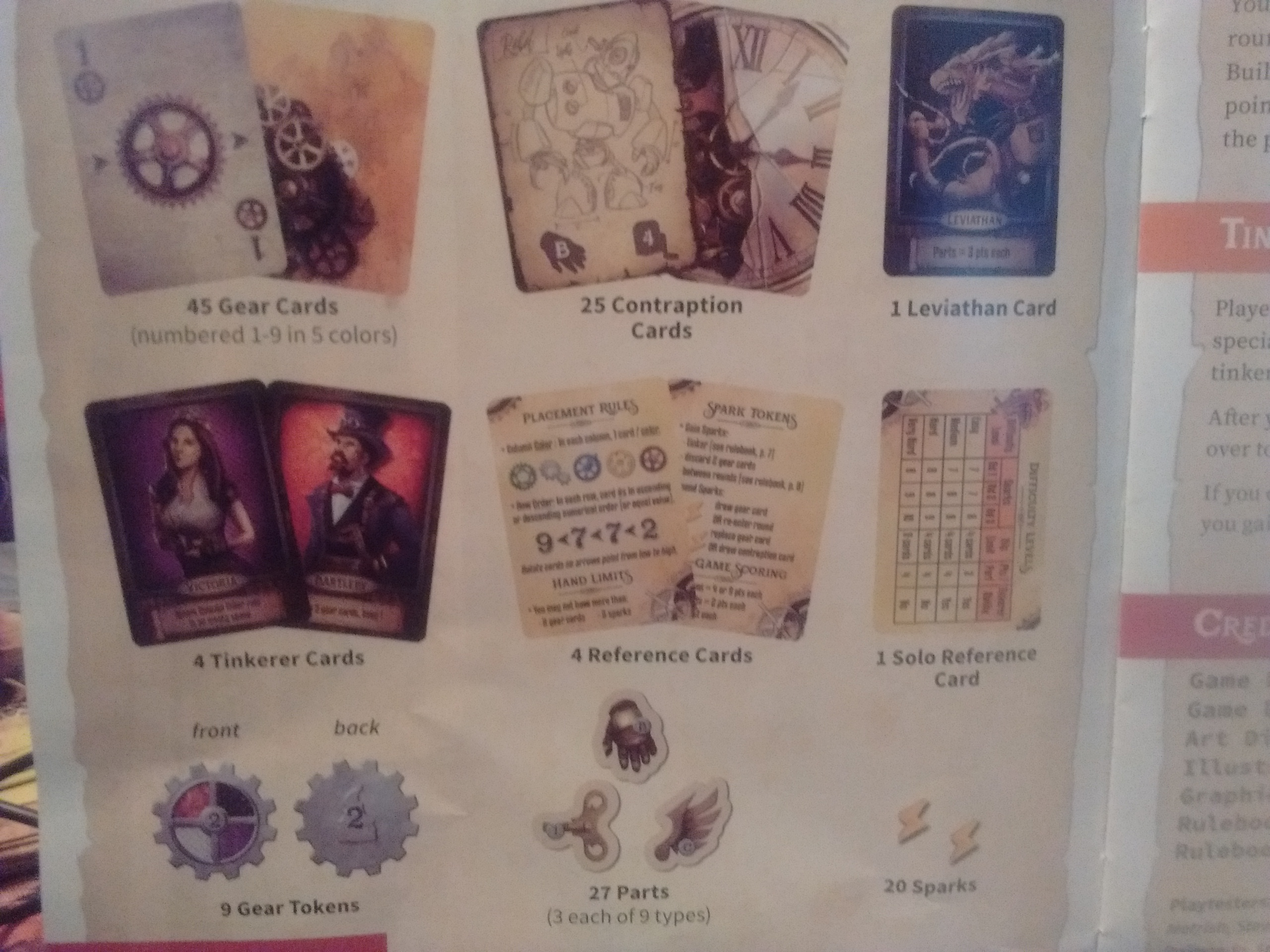
There are two versions of this game: The one version requires two to four players and the other version is a solo adventure. In the two to four player version, you play as one of four tinkerers in a workshop repairing a clock machine. To do so, you must acquire parts for the contraptions you are handed at the start of the game and in doing so will earn you points. There are other ways to earn points, but they accrue at the end of the game. The main way to earn points is to gain parts for as many of your contraptions as possible.
The way to earn parts is by placing your gear cards on a grid shown below.
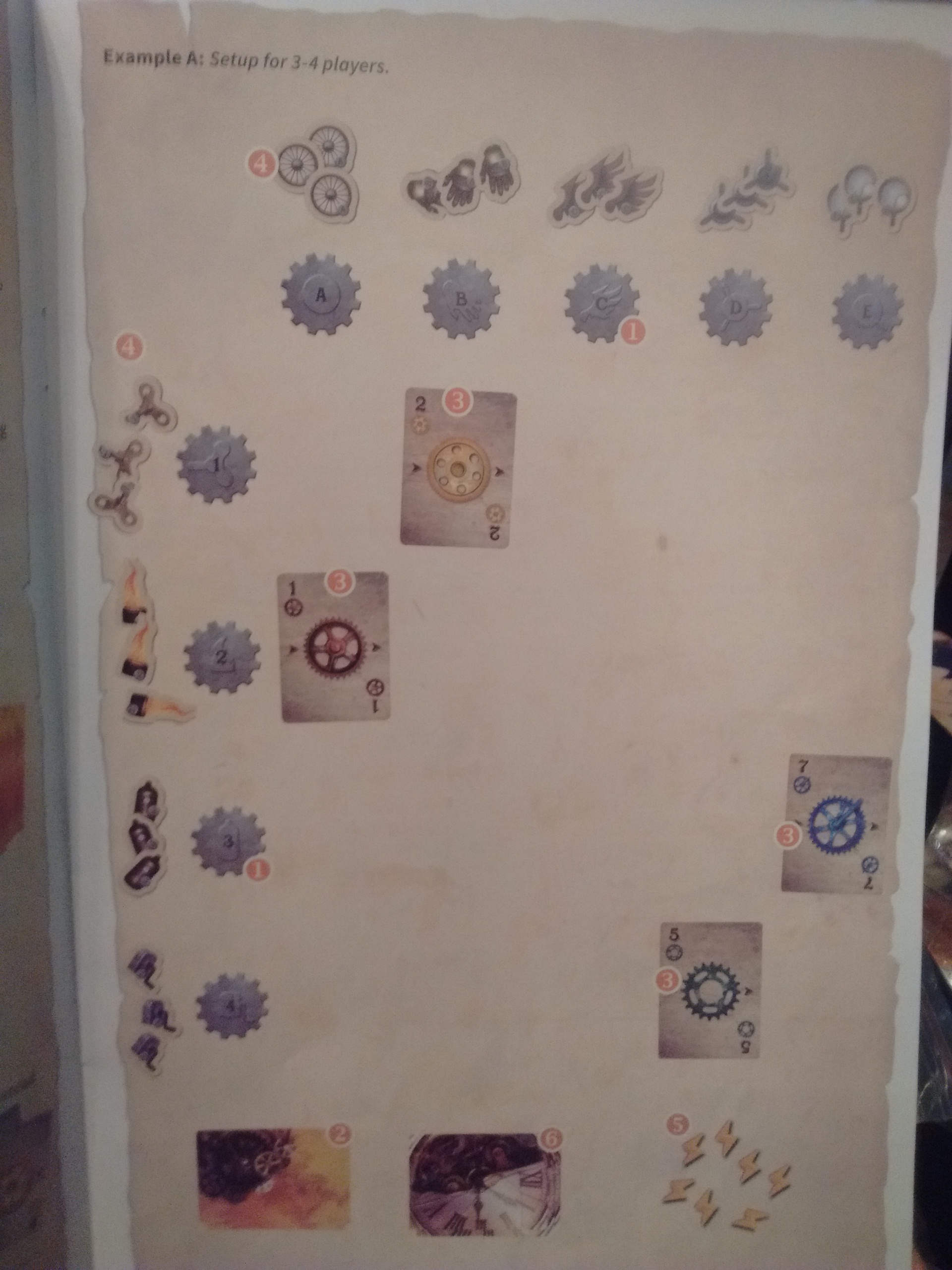
The setup is very easy. The gear cards (3) are placed where they need to be to start the game. For two players, place the cards in locations A2, B1, C4, D4.
This is how you play the game. There are three rounds. Every player takes a turn and continues around until everyone passes. You are given 5 gear cards face down and, on your turn, place one card anywhere on the open grid. You must place a card on the grid or pass. However, there are certain rules in placing the cards. For every column, there can only be one card for each color, no two cards of the same color are allowed. For every row, the numerical value of the cards must be either going from ascending to descending order. However, the card value can be the same if it is placed next to another card of the same numerical value.
When you place a card down, you flip over the gear tokens (1) and rotate it so that the color of your tinkerer card is facing the grid. This indicates you now control the specific row/column. At the end of the round when everyone has passed, each player collects the parts associated to the row/column they control at the end of the round. Then, you apply it to the contraption card and earn points. An example of game play is shown below.
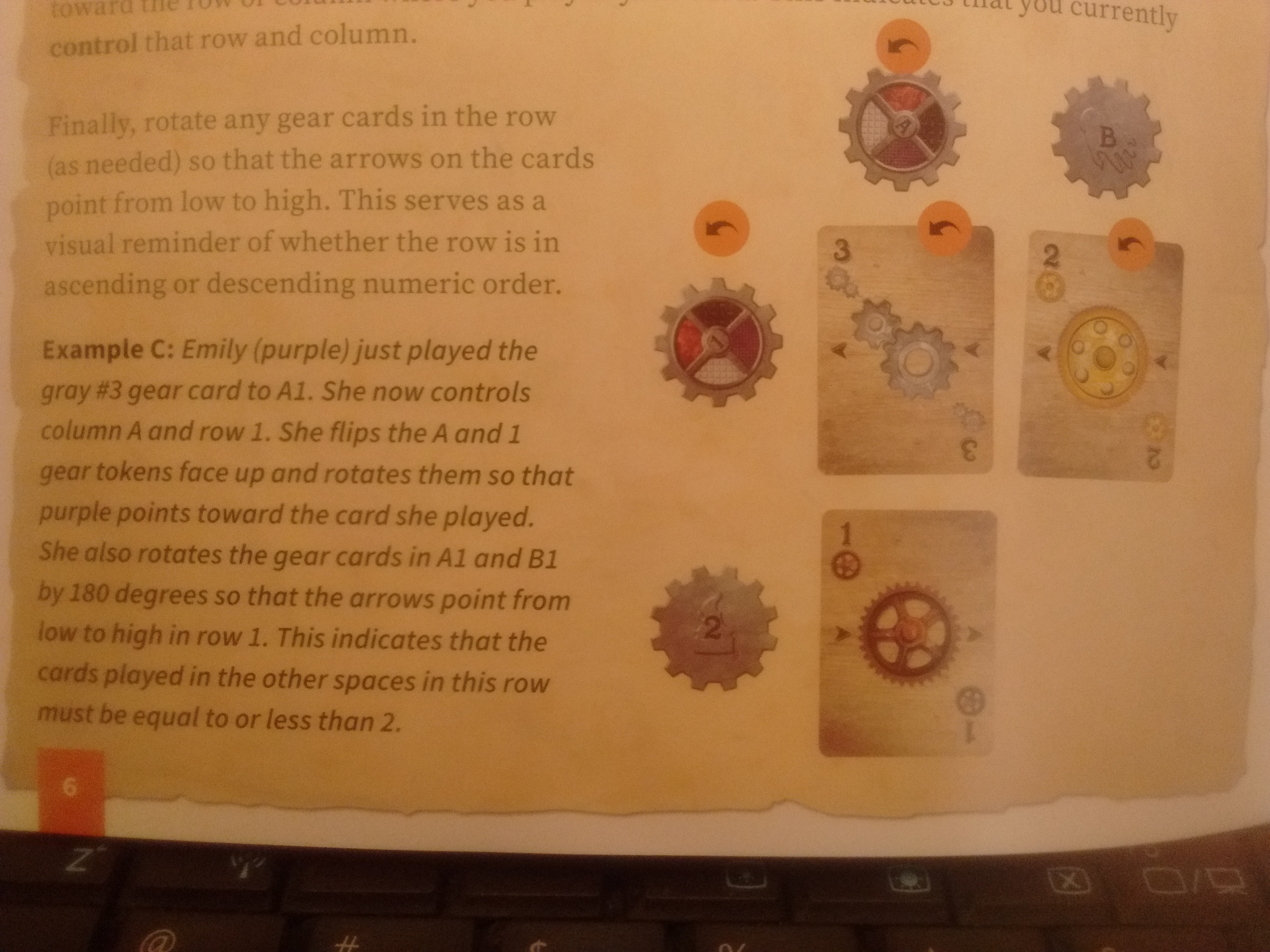
Now, here is where you need to remember your basic math skills. If you place the card with the value 3 on it like shown above, you gain a “spark.” You gain this spark because the two cards next to the card 3 add up to three. You can gain a spark the same way if the difference equals the card you played, also (i.e. I played the 2 card and the cards next to it are 7 and 9.) The spark allows you to do a lot of things from placing your card on top of another card, gaining another gear card, to allowing you back into the round you previously passed in.
The instructions says it will take about 30 to 45 minutes, but expect to play it for double the time for the first time playing. It, also, says it is for 10 year olds or above, but I think it could be playable for as young as seven year olds.
The single player is similar to the two to three and four player game, but you play against a monstrous machine called the Leviathan to stop it from destroying the clock machine you are trying to repair. The Leviathan places its cards by the contraption card’s letter on it. I haven’t had to play this version, but when Christmas break comes around I will be trying it out.
The game play is solid. It keeps you focus on the game with each turn forcing you to figure out how to take control of the rows/columns while trying to stop the other tinkerers at the same time. I highly recommend this game for anyone who wants to play a simple setup, but complicated game play. 🙂
 Derfferd's Adventures in Board Games